


45 OSCE participating States submitted hate crime information to ODIHR for 2025. Of these, 40 provided statistics, while 30 provided police statistics disaggregated by bias motivation.
The official figures are complemented by reports on hate incidents from 103 civil society groups, covering 51 participating States. These contributions amount to 11,318 hate incidents, including 8,489 statistical incidents and 2,829 incidents for which detailed descriptions were provided. This information includes incidents provided by the Holy See, UNHCR and OSCE missions.
Click here for the full PDF version of the visual below
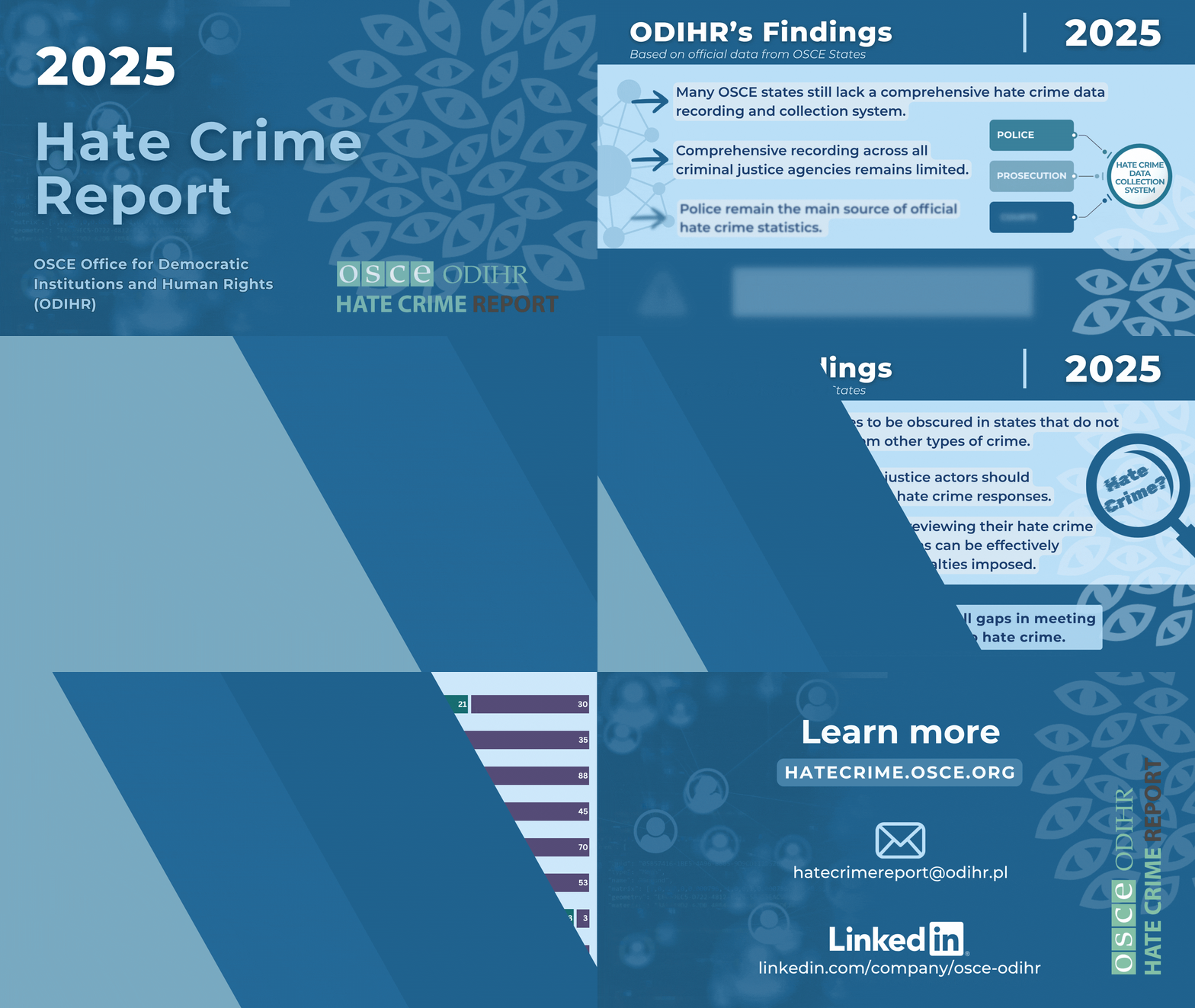
General challenges to addressing hate crimes
For 2025, ODIHR observed a slight decrease in the number of states that submitted data and information for the Hate Crime Report, as well as a similar decrease in the number of incidents submitted by civil society organizations (CSOs).
A total of 12 OSCE participating States did not meet their basic commitment to collect hate crime information and statistics and report it to ODIHR. Of these, eight states have not nominated a national point of contact responsible for submitting hate crime data to ODIHR. In many OSCE States, ODIHR continues to observe a low level of hate crime data recorded by prosecution services and the courts, compared to the higher levels recorded by police. Reliable and accurate hate crime data are essential to developing targeted and effective responses to address hate crimes and to supporting victimized communities. To this end, States must strengthen institutional arrangements, co-ordination mechanisms and policy frameworks towards a more coherent criminal justice response to addressing hate crime.
According to information submitted to ODIHR’s Hate Crime Report this year, bias motivations are recorded by police in just 30 out of 40 participating States that submitted official statistics to ODIHR, with further gaps in recording by prosecutors and the courts. Where bias motivations are recorded, recording is often limited to the identity characteristics set out in national legislation and restricted to a single bias motivation per incident.
In this regard, ODIHR observes that many states would benefit from improving their hate crime legislation, recording mechanisms, and technical guidance to collect comprehensive data on hate crime bias motivations at all levels of the criminal justice system. In particular, broader bias motivation categories, such as "race", ethnicity, or religion, do not provide enough information to identify the specific communities affected by hate crime. Therefore, recording categories must reflect the specific protected characteristics targeted and allow for the recording of multiple bias motivations per incident. Further, some states would benefit from introducing or reviewing their hate crime laws, so that bias motivations can be effectively acknowledged and appropriate penalties imposed on the perpetrators.
More detailed data on the bias motivations underlying hate crimes would allow authorities to better understand patterns of victimization, identify the needs of affected communities, and develop targeted and evidence-based policies to prevent and respond to hate crime.
In addition to a decrease in the number of hate incidents, ODIHR also observes a decrease in the number of civil society organizations that reported hate incidents. In addition, some victim groups remain significantly under-represented in reporting by civil society. This indicates that the capacity of some CSOs to monitor hate incidents and support vulnerable groups remains limited, in particular as a result of funding cuts affecting civil society. It is essential that states provide civil society groups with sufficient funding, revoke repressive legislation and engage civil society actors in designing policies, strategies and programmes as part of a comprehensive approach to address hate crime.
ODIHR stands ready to offer assistance to OSCE participating States to help them strengthen hate crime data collection, ensure a co-ordinated and coherent response to hate crimes, and deepen co-operation with civil society, including through the provision of comprehensive resources, capacity-building support, and tailored advice and expertise.